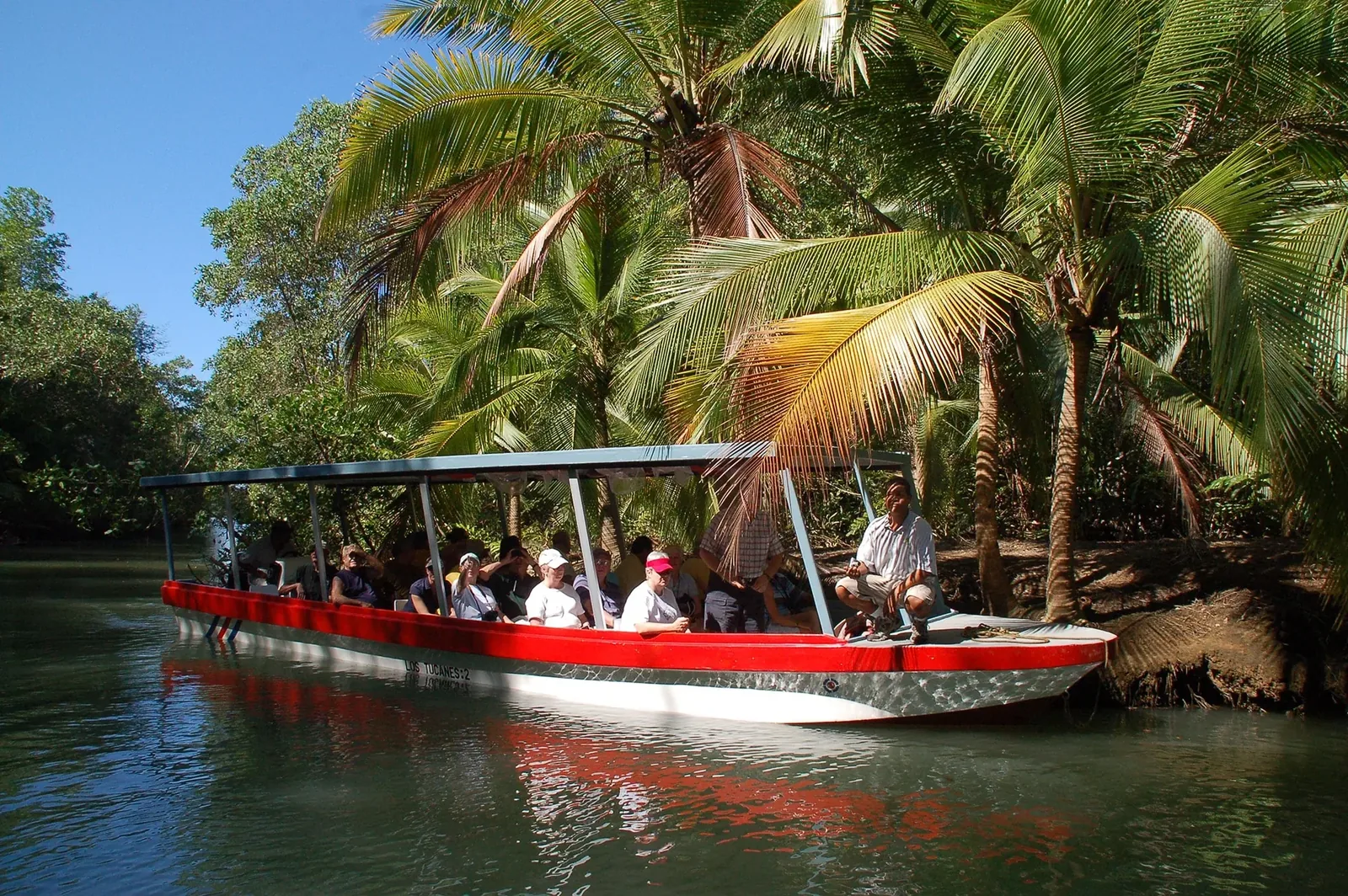
Short version: the Isla Damas estuary sits about 20 minutes north of the Manuel Antonio hotels, where the Paquita river meets the Pacific in a maze of mangrove channels. It is the most reliable wildlife watching in the area and asks nothing of you physically. Two ways in: a covered boat ($87, no paddling, best for families and photographers) or a kayak ($85, quieter and closer to the water). Both run on the tides, both include hotel pickup, a bilingual naturalist guide and a meal, and both take about four hours.
What the Isla Damas estuary actually is
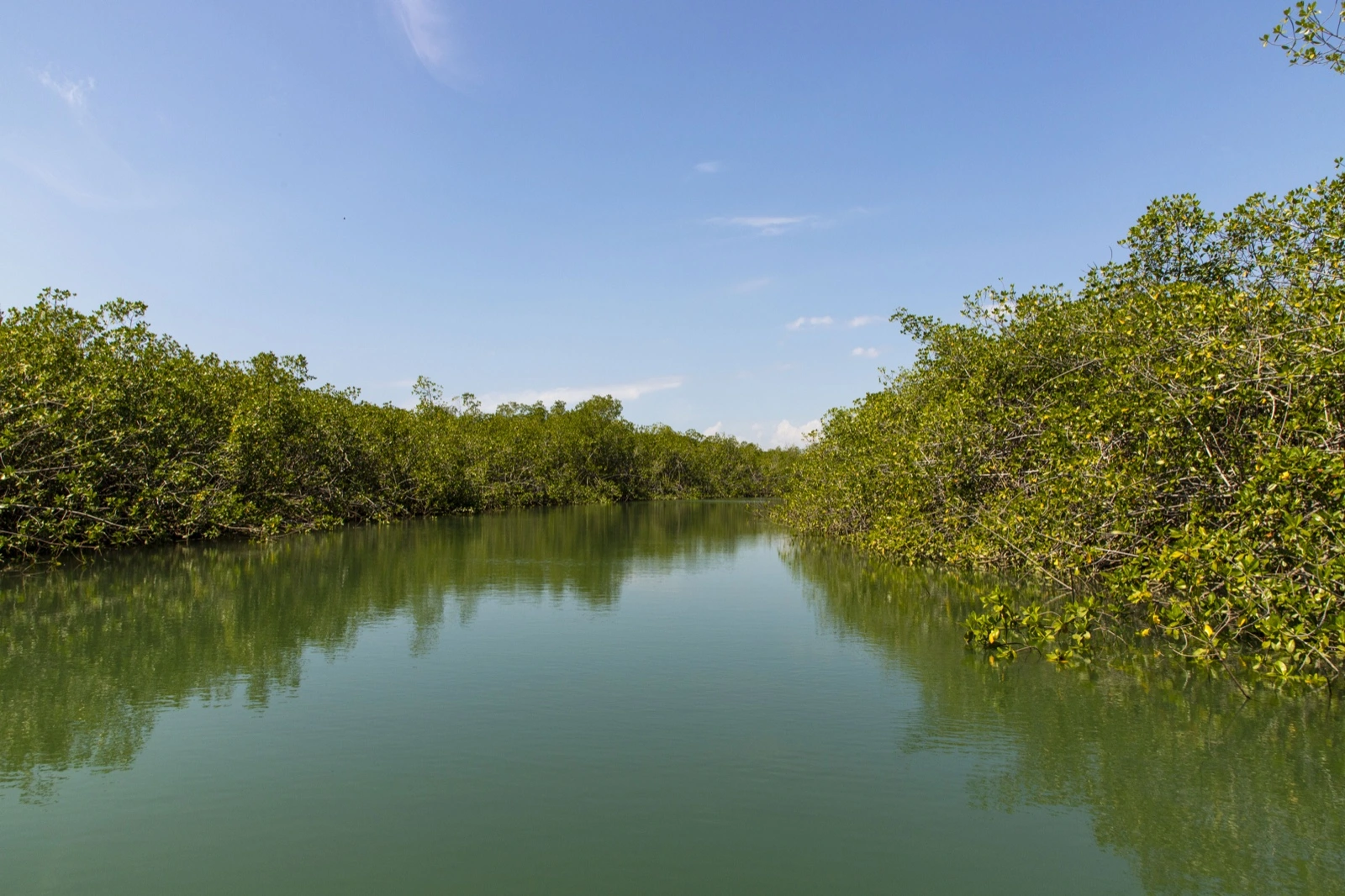
Most people picture a river when we say mangrove tour. It is closer to a maze. Where the Paquita river meets the Pacific just north of Quepos, salt water and fresh water mix into a brackish network of channels that wind between islands of red, black and white mangrove. The roots arch out of the water and knit together overhead until parts of it feel like a tunnel.
That tangle is the whole point. Mangrove roots trap sediment and shelter juvenile fish, which brings in the birds, which brings in everything else. It is a nursery, a rookery and a highway at once, which is why you see more animals in four slow hours here than in a hard day of hiking somewhere drier.
It is also protected water. There is no swell, no current worth mentioning, and no long boat ride to get there. For anyone who gets queasy on the ocean or is travelling with grandparents and small kids, that matters more than any brochure line.
Why mangroves matter more than they look
A mangrove forest photographs as a swamp and functions as infrastructure. These trees live where almost nothing else can, in salt water that would kill an ordinary tree, and they earn their keep in ways that are easy to miss from a boat seat.
They are a nursery. A large share of the fish caught commercially along this coast spend part of their early life inside root systems like these, where the tangle keeps bigger predators out. Snook, snapper and jack all pass through. When people ask why the fishing around Quepos is good, part of the answer is this estuary.
They hold the coast together. Mangrove roots trap sediment and absorb wave energy, so the shoreline behind them erodes far more slowly. In storm season that root wall is doing real work for the farms and houses inland.
They store carbon at a rate that embarrasses rainforest. Mangroves lock away several times more carbon per hectare than most terrestrial forests, and most of it goes into waterlogged soil where it stays put for centuries rather than into wood that eventually rots or burns. Costa Rica has lost mangrove cover to shrimp farms and development elsewhere in the country, which is exactly why the protected estuaries still standing matter.
Four species share the channels here, and once a guide points out the differences you cannot unsee them. Red mangrove stands on stilt roots at the water's edge. Black mangrove pushes finger-like snorkels up out of the mud to breathe. White mangrove grows tallest and forms the canopy. Piñuela has a buttressed trunk that people compare to the Eiffel Tower. Each one deals with salt and low-oxygen mud differently, which is how they manage to stack into one forest instead of competing each other out.
What you actually see out there
Birds are the headliners. Herons stalk the shallows, kingfishers work the channel edges, ospreys sit high in the dead branches, and frigate birds ride the thermals over the river mouth. Bring a zoom lens if you own one; even a modest one changes what you come home with.
Here is the realistic list, with how often each one actually turns up. Nothing in a wild estuary is guaranteed, and any operator who guarantees it is selling you something.
| Species | Where to look | Odds |
|---|---|---|
| Herons and egrets | Shallow edges and exposed mud at low water | Almost every trip |
| Kingfishers | Low branches over the channel, hunting | Almost every trip |
| White-faced capuchin monkeys | Crossing overhead where the canopy closes | Almost every trip |
| Iguanas and basilisks | Draped on sunlit branches; basilisks run the water | Almost every trip |
| Ospreys and frigate birds | High over the river mouth | Common |
| Crocodiles and caimans | Still, in the mud where channels widen | Common |
| Sloths | Wedged high in the canopy, barely moving | Common |
| Mangrove crabs and mudskippers | On the roots themselves at low tide | Common |
| Silky anteater | Curled in a ball in dense branches | Lucky day |
| Boa constrictor | Coiled on an overhanging limb | Lucky day |
| Roseate spoonbill | Feeding in open shallows, unmistakable pink | Seasonal |
What you see also depends on when you go, which brings us to the tides.
Is this the "Monkey Mangrove Tour"?
Yes, and it is worth explaining why the name exists. You will see this trip sold as the Monkey Mangrove Tour or the Mangrove Monkey Tour, especially by operators working out of Jacó and Herradura. It is the same Isla Damas estuary described here, and white-faced capuchin monkeys really are one of the animals you are most likely to see.
The nickname comes from a practice we do not follow. Some boats bait monkeys aboard with bananas so guests can hand-feed them, and a few guides will flick water at herons and iguanas to make them move for a better photo. Feeding wildlife is illegal in Costa Rica. It makes a troop dependent on boats, it makes them bolder and more aggressive with people, and it passes disease between species in both directions.
Our guides do not feed anything, and they do not chase animals for a shot. You still see monkeys out here, because the estuary is their home and the canopy closes right over the channel in places. The difference is that what you photograph is an animal behaving normally rather than one that has learned to beg.
Why the tour time changes every day
The mangroves run on tide, not on a schedule. At low water some channels are simply too shallow to enter, and at the wrong stage of the tide the wildlife is dispersed and hard to find. So the departure time moves day by day, and your pickup will be set around when the estuary is actually worth being in.
This is the single most common surprise for visitors, so plan around it rather than against it: on the day of your tour, we tell you when we are collecting you. Book any other activity for the far end of that day, not right after.
Because the timing floats, the included meal floats with it. Depending on your slot you get breakfast, lunch or dinner before or after the boat, not a fixed lunch at noon.
Boat or kayak: which one is right for you
Same estuary, same wildlife, two different days out. We run both, and we would rather put you on the right one than sell you the more expensive one.
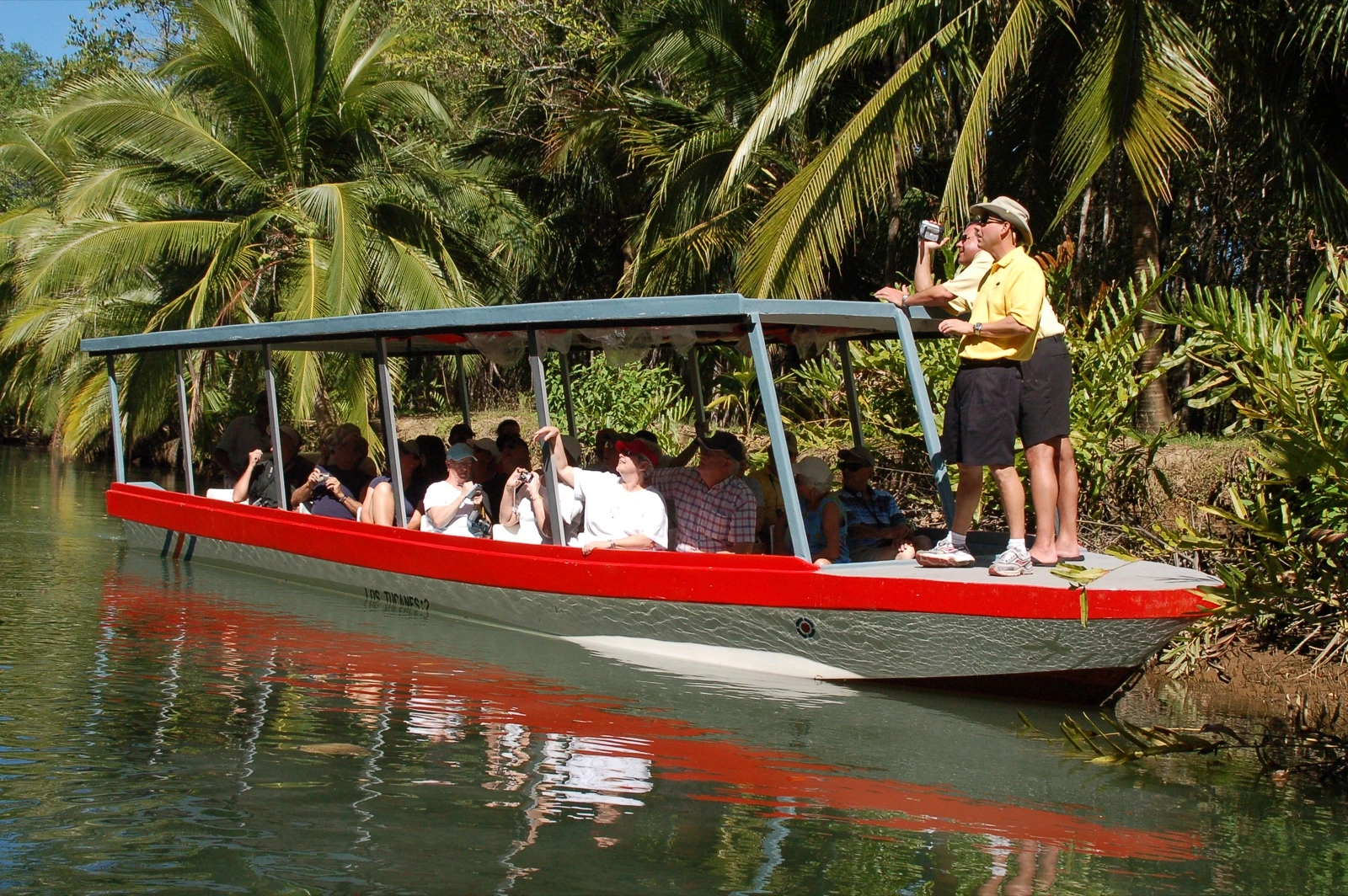
Take the boat if you are travelling with kids or grandparents, if anyone has mobility or shoulder issues, if photography is the priority, or if you simply want to sit still and be shown things. It is a covered, comfortable boat, there is no paddling at all, and the guide does the spotting while you look. This is also the better choice in the heat of the day, since you are out of the sun.
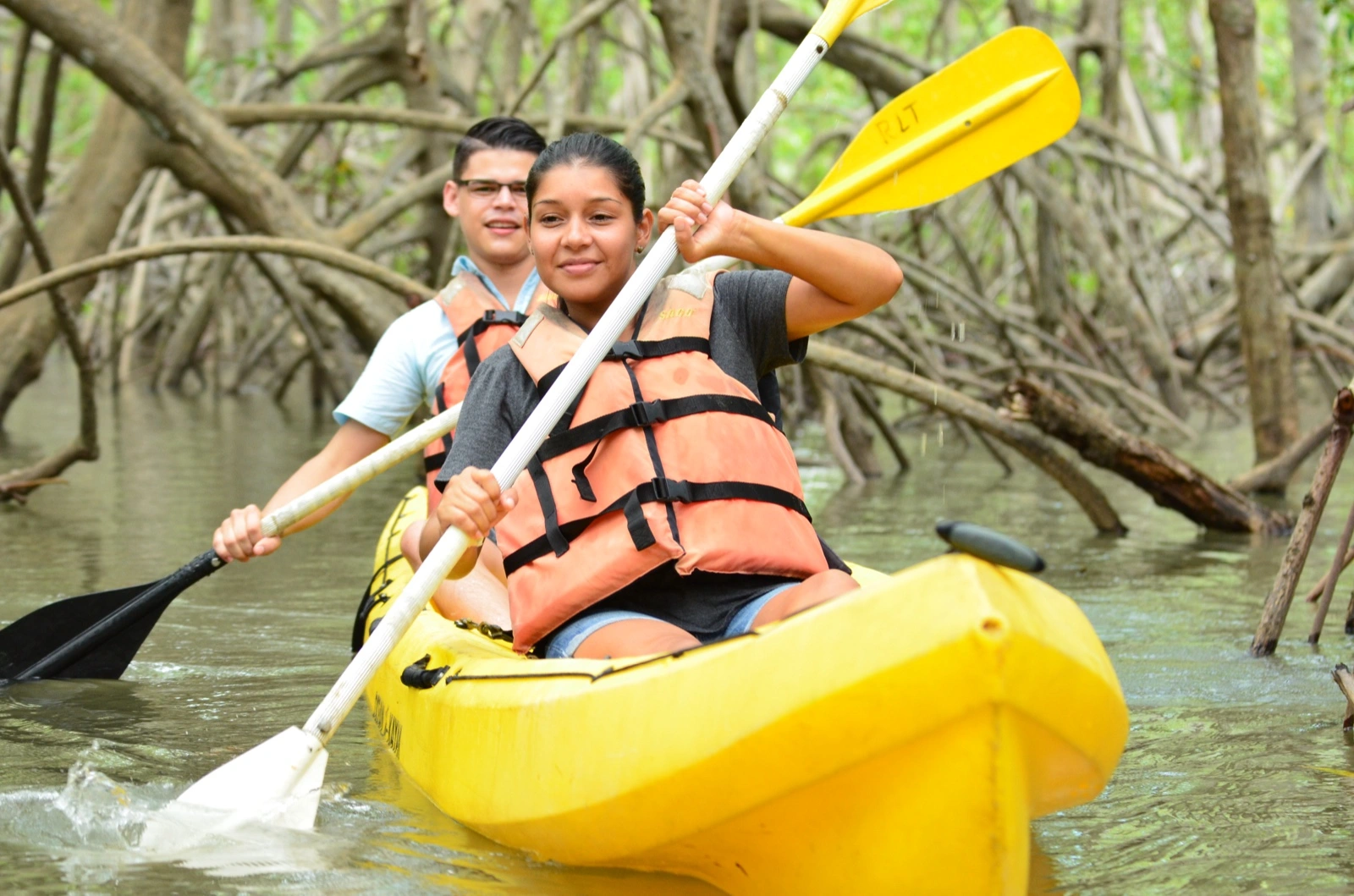
Take the kayak if you want the estuary quiet. A paddle makes almost no sound, so you drift closer before anything moves, and you sit low enough to be at eye level with the roots and the water. The channels are sheltered with little current, so it is a relaxed paddle rather than a workout, and no experience is needed. It is not the right pick for very young children or anyone who will struggle with a couple of hours of light paddling.
Prices are almost identical: $87 for the boat tour, $85 for the kayak, both per person from Manuel Antonio, both before Costa Rica's 13% VAT, both including hotel pickup, guide and a meal. Choose on comfort and pace, not on price.
"The kayaking route is great for beginners or paddling lovers. There is so much wildlife to see and cool areas to explore within the mangroves. The guide did a great job sharing tons of information about the area and ecosystem while also explaining the culture of the people of this area as well."
Carter · TripAdvisor review of the Damas Island kayak tourWhat guests say
The kayak version of this trip holds a 4.6 out of 5 across 82 TripAdvisor reviews, and Tucanes overall sits at 4.8 from more than 1,500. The pattern in the mangrove reviews is consistent: people come for the scenery and end up talking about the guide.
Mangroves exploration in a kayak
"This tour was a delight! Kayaking through the mangroves was peaceful, the scenery was beautiful and our guide, Jacob was awesome! We enjoyed learning about the wildlife and vegetation along the way."
Karalew15 · June 2026
Birdwatcher's delight
"We spent most of the tour trying to track down a specific bird I wanted to see. We didn't find it, but we saw several other really cool birds that I hadn't seen anywhere else. The mangrove swamps themselves have a certain magic and peace to them that is unlike anything else."
Margo L · March 2026
A great experience
"Each kayak had 2 people and it was quite easy to get the hang of it, even for us who had never kayaked before. The guides were excellent."
vlr759 · August 2025
Read them all on TripAdvisor.
What to bring
- Insect repellent. Mangroves and mosquitoes come as a set, especially at dawn and dusk slots.
- Sun protection. Hat, sunglasses and reef-safe sunscreen, even on the covered boat; light bounces hard off the water.
- A camera with some zoom. Phone cameras do fine on the scenery and poorly on a heron thirty metres off.
- Binoculars if you own a pair. The guide carries a scope, but having your own changes the birding.
- Light long sleeves. More about bugs and sun than cold.
- A dry bag or ziplock for phones on the kayak version.
Getting there from Manuel Antonio, Quepos and Jacó
From the Manuel Antonio and Quepos hotels it is about a 20-minute drive, and round-trip transportation is included, so there is nothing to arrange or park. From Jacó the same tour runs as a longer day with pickup earlier in the morning; see tours from Jacó for the details on that departure.
If you are still working out how to reach the area at all, our guide to getting to Quepos and Manuel Antonio from San José covers the drive, the shuttles and the small plane, and our private shuttles and transfers can bring you in the day before.
Booking and price
The Isla Damas Mangrove Boat Tour is $87 per person from Manuel Antonio and runs about four hours door to door. The Isla Damas Mangrove Kayak Tour is $85 per person over a similar window. Both prices are before the 13% VAT and both include round-trip hotel pickup, a certified bilingual naturalist guide, and a meal with beverages.
Because departures follow the tides, some days have only one workable slot, and those fill first in high season. A few days of notice is usually enough; a week is better between December and April.
Anglers, note that the same estuary fishes well: we also run an Isla Damas mangrove fishing charter for snook and snapper in these channels.
Frequently asked questions
How long is the Isla Damas mangrove tour?
About four hours door to door from Manuel Antonio, including the 20-minute drive each way, the guided time in the channels and the included meal.
What wildlife will I see in the Damas Island mangroves?
Herons, kingfishers, white-faced capuchin monkeys and iguanas turn up on almost every trip. Ospreys, frigate birds, crocodiles, sloths and mangrove crabs are common. Silky anteaters, boa constrictors and roseate spoonbills are lucky-day sightings. Nothing is guaranteed, but the density of animals in this estuary is high compared to most wildlife tours in the area.
Is the mangrove tour better by boat or kayak?
The boat suits families, older travellers and photographers: it is covered, there is no paddling and the guide does the spotting. The kayak suits people who want silence and want to sit low at the water line. Same estuary and same wildlife either way, and the prices are nearly identical at $87 and $85.
Why does the tour time change from day to day?
The channels are only navigable at certain stages of the tide, and wildlife activity follows the water too. Departure is set around the tide for your date, so your pickup time is confirmed for the day you are booked rather than fixed year round.
How much does the Isla Damas mangrove tour cost?
$87 per person for the boat tour and $85 for the kayak tour from Manuel Antonio, before Costa Rica's 13% VAT. Both include round-trip hotel pickup, a certified bilingual naturalist guide and a meal with beverages.
Is the mangrove tour suitable for young children and seniors?
The boat tour is, yes. It is flat, sheltered water with no paddling and no strenuous walking, which is why we point families and grandparents toward it. The kayak version asks for a couple of hours of light paddling and suits older kids and adults better.
How far is Isla Damas from Manuel Antonio?
Roughly 20 minutes by road from the Manuel Antonio hotel zone, just north of Quepos at the mouth of the Paquita river. Hotel pickup and drop-off are included, so you do not need a car.
Which mangrove species grow at Isla Damas?
Four: red mangrove on its stilt roots at the water's edge, black mangrove with the finger-like breathing roots in the mud, white mangrove forming the tall canopy, and piñuela with its buttressed trunk. Guides point out the differences as you pass them.
Do I need to book the mangrove tour in advance?
Yes, particularly in the December to April high season. Tide windows mean some days have only one workable departure, so those slots go first. A few days of notice is usually enough outside peak weeks.
Is this the same as the Monkey Mangrove Tour?
Yes. Operators working from Jacó often sell this same Isla Damas estuary as the Monkey Mangrove Tour or Mangrove Monkey Tour, and white-faced capuchins are among the most common sightings. The name comes from boats that bait monkeys with fruit, which is illegal in Costa Rica and bad for the troop. Tucanes guides do not feed or bait any wildlife.
Keep planning
The mangroves pair naturally with the rest of a wildlife-led week here. The best spots to see sloths in Manuel Antonio covers the land version of the same hunt, our kayak trip report from this estuary gets into what paddling it feels like, and things to do in Manuel Antonio, Jacó and Quepos lays out the wider area. For everything running while you are here, browse all Tucanes tours.